This post is (also) available in: NederlandsFrançais
The search screen
In Belga.press-tablet, you’ll find the search features at the top of the menu bar. Clicking the search button takes you to the Belga.press search screen.
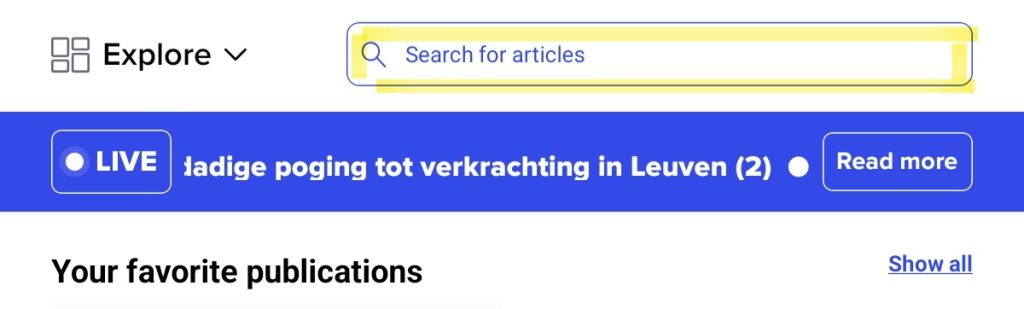
At the top, you’ll find the search bar where you can enter your search terms. To the right and right under the search bar are all the search filters. In the middle of the screen, you’ll find a list of all your saved searches, and below that, your previous searches. As soon as you launch a search, the results will appear here in the middle section.
Assisted vs Boolean Search
There are two ways to search on Belga.press. You can use the assisted search or search using a Boolean query (more specific search).
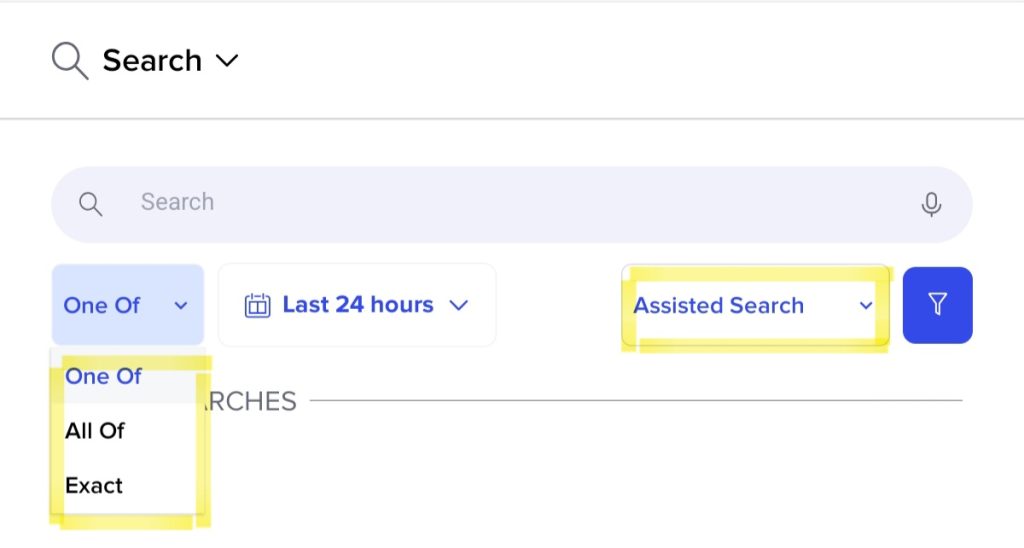
By standard, the assisted search is available, offering you a choice of three options. You’ll find these options below the search bar on the left-hand side, under ‘Select Item’. Let’s take a search for Elon Musk, the CEO of Tesla, as an example. If you use ‘One of’, you’ll get articles that mention either Elon or Musk. If you select ‘All of’, you’ll get articles containing both “Elon” and “Musk”. If you select ‘Exact’, you’ll get articles containing Elon Musk in exactly that order.
If you want to perform a Boolean search, right-click on the ‘Select Item’ option below the search bar. Belgapress supports most Boolean search operators. The most common ones are AND, OR and NOT. For other, more specialised operators, please refer to our tutorial on advanced search.
Let’s go back to our example of Elon Musk, but this time we’ll conduct a slightly more detailed search. In our example search query, we put ‘Elon Musk’ in quotation marks because we want to search for the exact phrase Elon Musk and not for Elon or Musk separately. We add ‘Tesla’ using AND. Now we’ll only get articles that mention both Elon Musk and Tesla. We add NOT followed by ‘spaceX’; this will exclude articles containing ‘spaceX’. If, on the other hand, we want to find all articles containing either ‘Elon Musk’ and ‘Tesla’ or ‘SpaceX’, we do this as follows. We put ‘Tesla’ and ‘SpaceX’ in brackets and place OR in the middle.
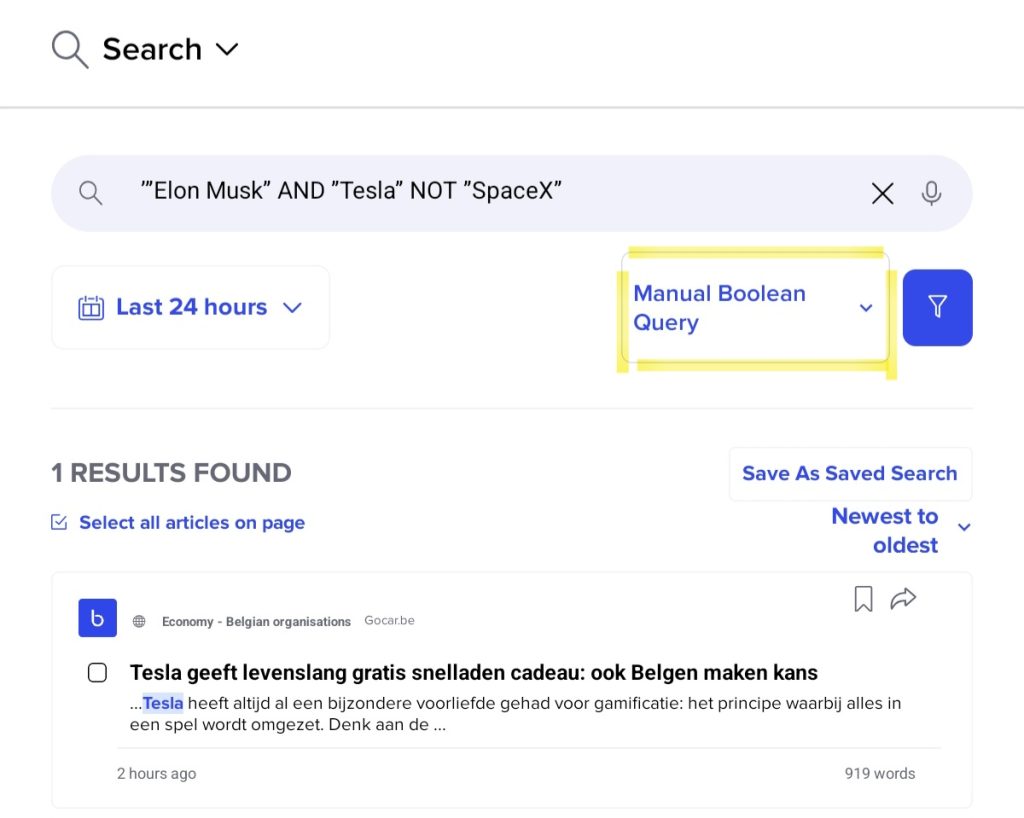
Thanks to Boolean searching, you can enter very complex queries. Please note that you must always type Boolean operators in capital letters and place exact terms that you wish to treat as a single unit within quotation marks.
Good to know: using very complex queries can slow down the search!
A wide range of search filters
Belga.press offers a wide range of search filters that allow you to narrow down your search results so you can find the articles you’re looking for. All filters can be found in the left-hand column.
You can access the filters via the blue button next to ‘Assisted Search’. Clicking the bin icon in the top right-hand corner resets all filters to their default settings. If you navigate to another page within Belga.press or log out, we will remember your filter settings.
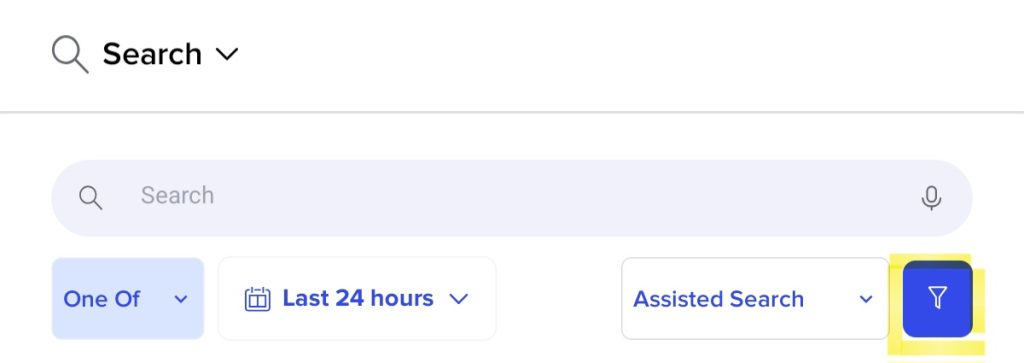
The first filter is the time period filter (period). Here, you can manually specify a time period within which you wish to search, or use one of the standard date filters. By default, the time period filter is set to “Last 24 hours”.
For our Elon Musk example, we’ll select “This month”. You’ll see that the search results are automatically updated when you select the filter.
The second filter is by content type. With this filter, you specify which content types should appear in your search results. If no filter is selected, this means you want to see all results within that filter. For our example, we’d like to see only newspaper and online articles.
The third filter is by language. With this filter, you can specify that you only want the search engine to return, for example, Dutch-language articles.
The fourth option is the ‘by country’ filter. Here, you can specify that you only want articles from the Belgian press, for example. It is therefore not about the country an article is about, but the country of the source.
In the fifth filter, you can select news brand groups. News brand groups are the categories into which news brands are organised by Belga. For our example, we only want articles published by a newspaper or television news brand.
The sixth filter is by news brand or source. Here, you can specify that you only want articles from certain brands or sources. For our example, we only want articles from Het Laatste Nieuws, Het Nieuwsblad and De Tijd. We only display the sources that remain based on the filters you set above. You can select a source from the (long) list or find it easily by starting to type its title into the search bar. After just three characters, you’ll immediately see the matching sources appear. Use the cross icon to return to the full list.
All your filter selections remain visible in the light grey bar so you can keep track of the choices you’ve made. Use the ‘delete’ icon to quickly remove them.
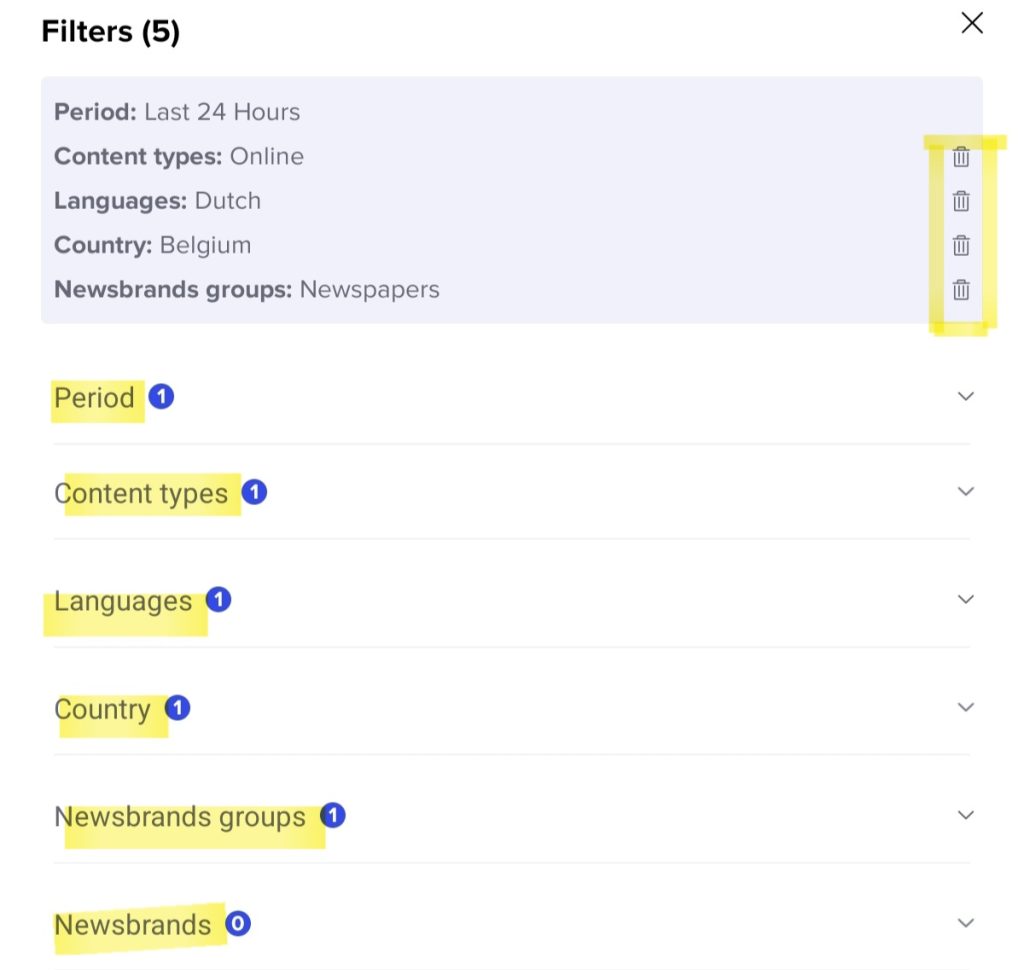
If you choose the ‘my newsbrands – select all’ option, you can select all your favourite news brands in one go. Click ‘select none’ to clear the selection.
Your search results and what to do with them
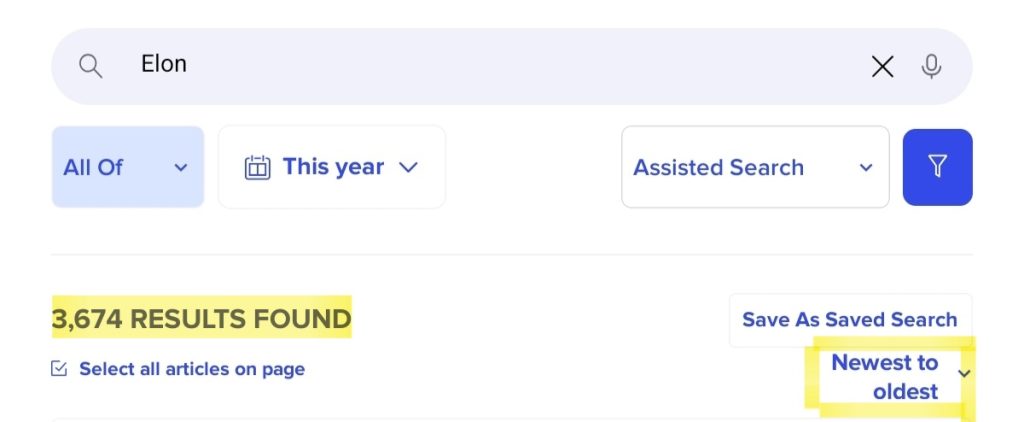
As soon as you launch a search, the central area of the screen fills with results. The search results update every time you apply a filter, and you can see the number of results displayed. You can sort them from newest to oldest (default), from oldest to newest, by relevance or by news outlet.
Now that you have your desired search results, it’s time to take a closer look at them. Click on an article to read it in full. You can perform various actions on the article.
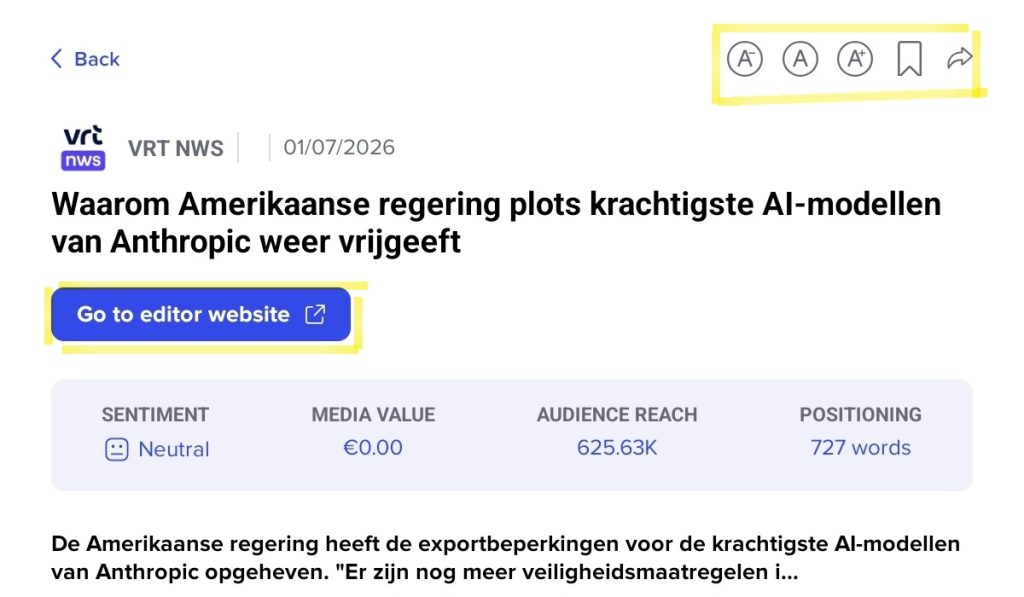
For a newspaper article, you’ll see a blue button in the top left-hand corner. If you click on this, the newspaper page will open in a new tab. For an online article, you can view the article in its original context by clicking on the icon next to the title.
At the top right of the article, you’ll find the Belga.press action buttons. Use the arrow to share an article. You can copy the Belga.press link and share it via various social media platforms. You can also email the article to anyone by typing in their email address (then click ‘Add contact’) or selecting a previous contact. You can also add a short note for the recipient in your email. You can share with multiple people, but not with a contact group; please note, however, that you can only share one article per source per month with the same person.
You can use the bookmark icon to save an article to read later. You’ll then find the article in your saved items.
Use the A buttons to change the text size: press A+ to increase the text size and A- to decrease it.
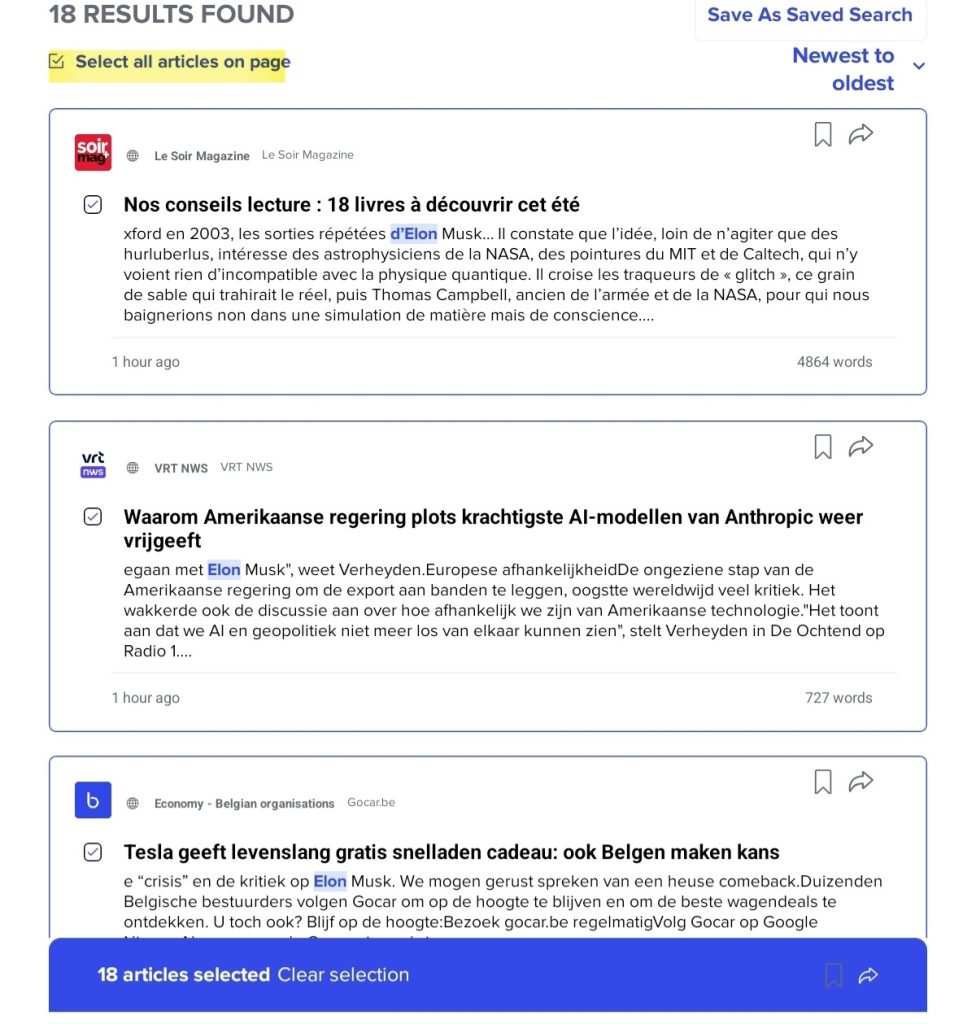
It is also possible to perform actions on several items at once. You can do this by ticking the checkboxes next to the items. The action buttons can then be found on the blue bar at the bottom of the screen.